How to let go of the past to fund your future
Three steps to reallocate funding to your AI-powered competitive moat
TLDR: Layoffs and traditional cost-cutting programs always fail. Instead, start with “what’s our competitive moat, and does (x) strengthen or dilute it?” Now you can reallocate money from value-subtracting to value-adding initiatives in a snap.
Don’t you love it when you find money? The other day, I found €10 in the side pocket of my backpack. It kind of felt like I was the luckiest person in the world. Great, free lunch!
That’s what can happen in your business when it comes to AI. I guarantee you there are thousands, if not millions, of dollars being spent on things that don’t really matter and would be better invested for your next chapter of growth.
The trick is figuring out where to put that money instead. And that’s where most AI transformations go wrong: they start with AI instead of the competitive advantage they’re trying to build.
The whole point of AI is to reinforce a competitive moat. If you’ve never decided what that competitive moat is (and what it isn’t), then it’s really hard to decide what to invest in. Which means the person with the strongest opinion wins.
A competitive moat is something you become
I should talk about what a competitive moat is. A competitive moat is something you become, not something that you build. The competitive moat is not something separate from your company. It is your company. It’s how you organize your talent, capabilities, processes, data, AI, everything around a customer value. Everything and everyone united to create that value together – reliably, efficiently, better and faster over time. That’s a competitive moat.
What’s brilliant about AI is that once you’ve defined what that moat is, AI expands it, and keeps expanding until no one can catch you. The virtuous cycle of implementing, learning, retraining the AI, and getting more data, more insight: the whole system gets smarter. Your talent gets better at working with AI and across functions, patching the gaps where value tends to leak.
My last article talked about lean AI transformation, but transformation needs to be in service of something. That something is turning your entire business into a competitive moat. In the lean model, you start with customer value and you reverse engineer everything that’s required to create that value. Building a competitive moat is exactly the same: start with value, because what are you going to build a moat around anyway?
Nobody cares about what you do
Are you building a moat around the fact that you create widgets? Nobody cares about your widgets. Nobody cares what your marketing people produce, or individual features without an emotion-grabbing experience that wraps around it, or a one-size fits all product or service. They only care about the outcome that they get from you that they can’t get anywhere else. What’s the value that they need? Different kinds of companies and buyers value different things.
Everyone talks about connecting AI to the business strategy to get an ROI, but they never talk about what kind of strategy is effective. And I’ve rarely seen a strategy that clearly says “this is the competitive moat that we’re building around this outcome for this kind of customer. Here’s where we invest, and here’s where we don’t invest.” Unless it’s a startup that’s literally just figured out their product market fit. Or it’s a wildly successful brand that doesn’t need help. Or it’s an AI native, because this is exactly how AI natives operate: everything aligned to create a clear customer outcome.
Like Intercom Fin, the AI help desk that charges for customer resolution (outcome) not usage. Like Cursor, which delivers faster, better quality coding (outcome).
I could mention Harvey, the legal AI tool with an $11B valuation, but it’s already proved too easy to copy. A Big Law associate vibe-coded an open-source alternative to Harvey, called MikeOSS, in a couple of weeks’ worth of nights and weekends. Legal research, contract analysis, due diligence – these are activities that are easily copied. But an outcome might be “we increase case velocity so you can handle more work with the same headcount.” Sure, that’s harder to pull off, but that’s exactly what makes a great competitive moat.
The shift from activities to outcomes makes customer understanding and strategy the most important capabilities today, hands down.
Traditional goals versus outcome goals
So let’s talk about the difference between traditional goals versus outcome goals. I keep this folder called my BS Folder in Raindrop. And one of the articles in my BS Folder is this quote from the CFO of Unilever, Srinivas Phatak. He says, “We are ruthlessly focusing on outcomes. And the three outcomes are: volume-led growth model, a gross margin-led profit expansion plan, and cash. So, it’s growth, it’s profit, it’s cash.” Really? Those aren’t useful outcomes. Every single company on the entire planet has those goals, and they do not help you prioritize investments.
And that’s what a good strategy does. A good strategy, an effective strategy, will make it blindingly obvious what to say no to so that you can say yes to what matters most. What matters most is the outcome you create for a particular kind of customer. The strategy and operating model inform how you create that outcome together.
Business outcomes like growth, profit and cash... that all naturally happens when you create customer value. They’re a result of customer value.
Here are three examples of how this works:
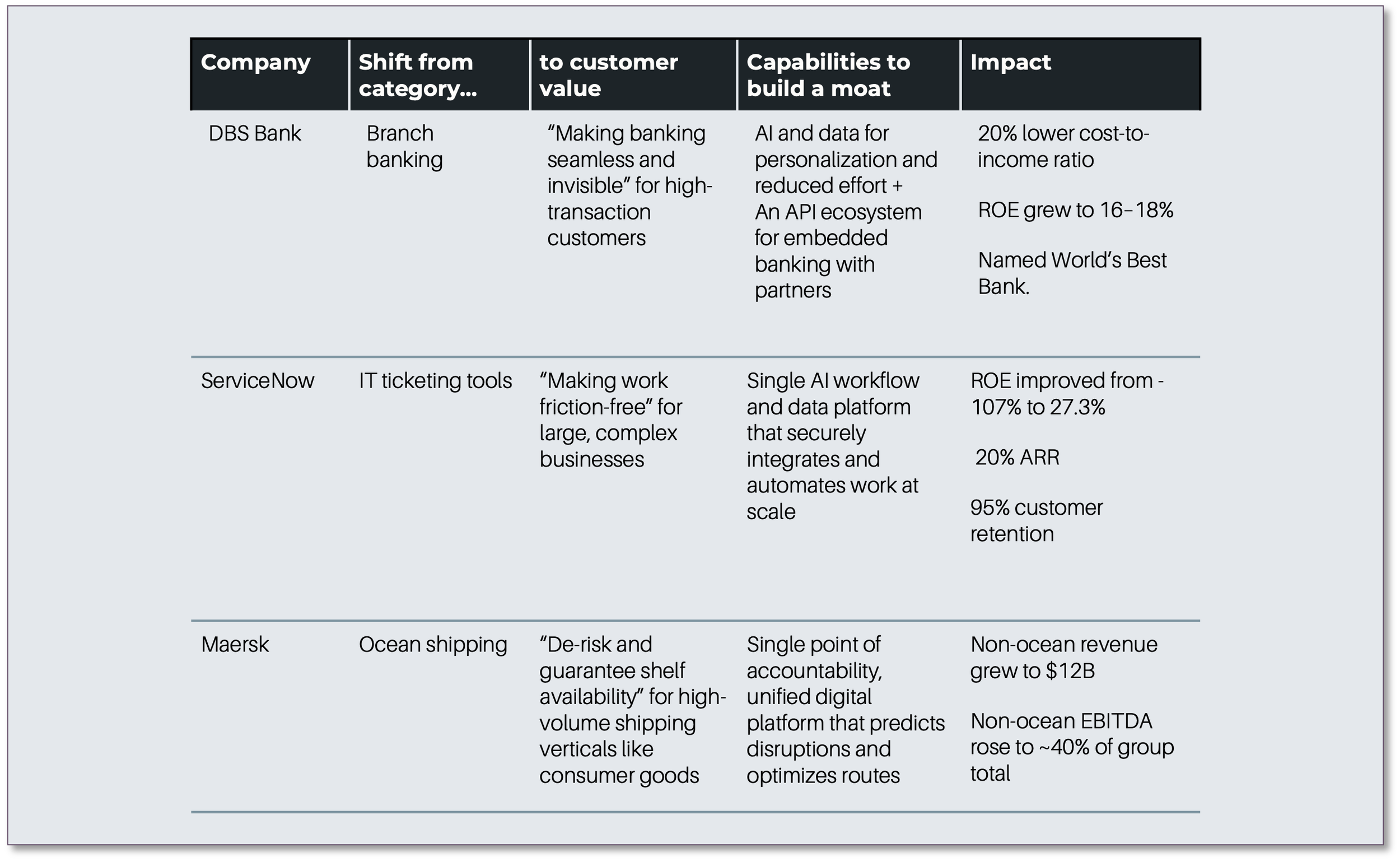
Look at what changed: these companies all got clearer on the value they create for a particular customer, then built capabilities to deliver it. And it paid off.
Three steps to fund the next chapter from money you already have
1. Start with value. Who’s your most valuable customer segment and what do they value most? And you can’t say “enterprise customers” because that’s still too vague. Take 10 accounts you can’t afford to lose and figure out what each really values. Some might need security and guarantees. Others might need their ego stroked and treated like they’re your best customer ever. Others don’t even want to deal with you at all; they just want tools and information to do it themselves.
This will require you to actually talk to decision makers, users, influencers. What do they really value? Then you get to choose one. Really, only one, and it must be different than what anyone else could create. No one can succeed by building 10 moats.
2. Then decide what capabilities you need to create that value. If you only had a dollar, where should that dollar be spent most effectively?
3. Lastly, map your current initiatives and big spending buckets. Which of these different initiatives directly support and reinforce your moat, and which ones are diluting it? The latter is what you reallocate.
I guarantee you, you will find piles of money from misaligned or duplicative programs that you can then push into your next chapter of growth: enabling you to hit all of your business objectives and see an ROI from AI.
Big launch offer - all from found money
If you need help, I’m doing this on a pay-on-performance basis. This is my official business launch offer – no money out of pocket, my fee comes out of the misaligned, lost money that’s been stashed in your pocket all this time.
You get an aligned SLT, clarity on your moat and where to invest, initial use cases, and funding. Win win. Email me for details.