If AI is a game, which one are you playing?
Three games, three operating systems. This article unpacks the underlying business logic you’ll need to understand before tackling AI transformation.
As an only child in a military family that was constantly on the move, my ability to entertain myself knew no bounds. I was the geeky kid who read encyclopedias for fun, created imaginary worlds, and played a lot of solitaire.
When I got old enough to play chess with my dad, I discovered that my solo game skills weren’t worth much. I had to look at the board from his perspective, consider what kind of moves he’d make, and start thinking a couple steps ahead.
Last year, Bill McDermott, CEO of ServiceNow, declared “we’re playing chess, not checkers.” This year he went further: “we manage everyone else’s board.”
He meant that they’re playing the long game and focusing on platform dominance, not features. What he didn’t say, but we’ll discuss in this article, is that they’re playing a 2-dimensional chess game while everyone else is playing one-dimensional solitaire. But even McDermott might be outplayed in a 3D game of Go.
Three dimensions, three games
Scan a LinkedIn feed of AI experts and you’ll get a hundred different takes on why AI is failing in most organizations. They’ll talk about data or adoption or workflows, and it’s all spot on. But there’s a much deeper root cause: AI flounders when leaders are playing a 1-dimensional game.
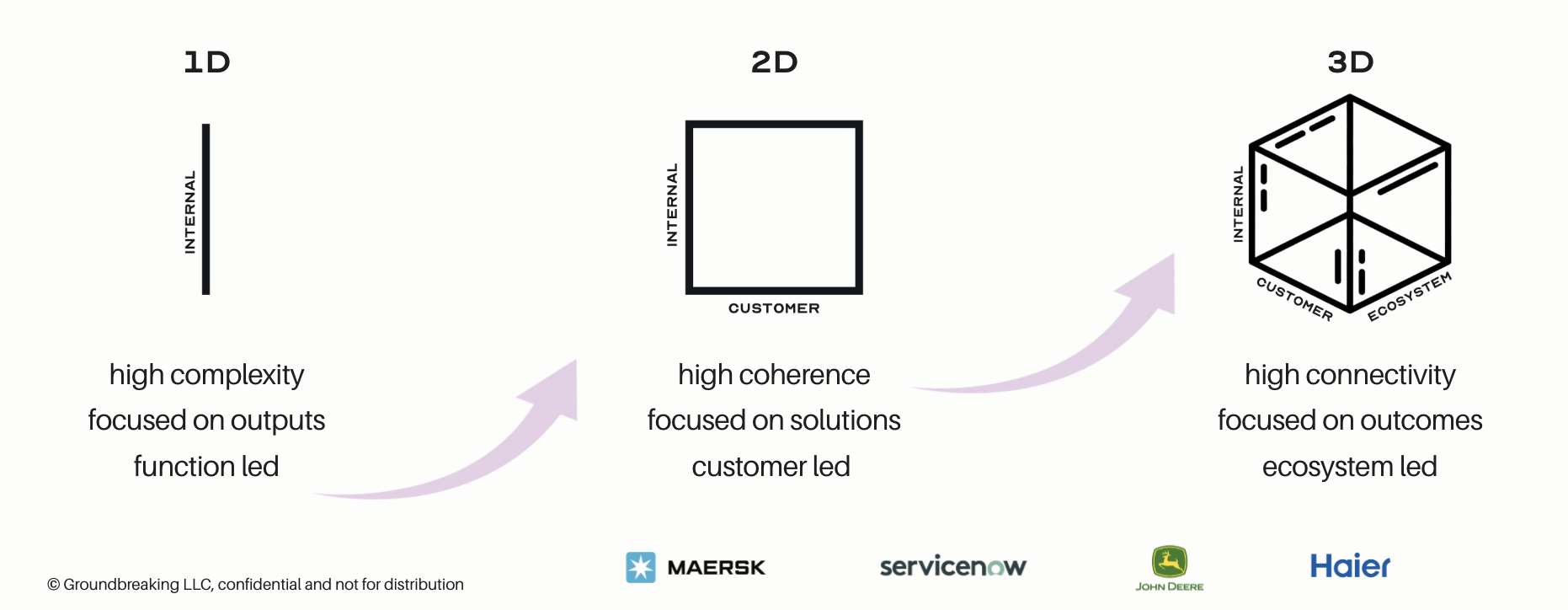
In business, there are three types of games, each with a fundamentally different perspective and worldview. Call them games or operating systems: we’re talking about the underlying operating logic that informs what you do and how you do it.
Below you’ll find an overview with example companies for each stage.

1D: Solitaire
Solitaire is a one-dimensional game: just you and the cards, playing against yourself.
Imagine each function in your company playing their own games of solitaire. Sales is playing sales. Marketing is playing marketing. Operations, finance, product, customer service: all heads down, each optimizing for their own hand.
Over time, these businesses add more customer segments, more features, more products, more geographies, all played like individual solitaire games. Nothing unites them. More is a plague inside sectors like financial services, energy and telco that serve consumer, SME and enterprises.
Take a company like BT, which sells broadband, mobile, TV, landlines, business networking, security, IT services, etc. to different customers with minimal coordination across functions. Not only is it massively inefficient, but the customer experience can be awful. BT gets a 1.3-star rating on Trustpilot, and revenues have been declining year over year.
One of my Fortune 100 clients once called this more phenomenon a “thousand points of light” that don’t add up to anything, but it’s not unique to enterprise: I see this pattern all the time in growth-stage and mid-market companies.
1D thinking creates a compounding downward spiral:
Inefficiencies and costs are high, so there’s a big push to get more customers.
Because there’s no clear customer focus, marketing and sales are incentivized to get anyone they can.
Because you can’t build a 1-size-fits-all solution, teams start adding piles of features to cover all the bases, which increases costs.
Because you can’t design a 1-size-fits-all customer experience, it only works for a small percentage of your customer base. The rest become unhappy and leave.
Which puts more pressure on sales and marketing.
In a 1D environment, AI makes everything worse. Sure, you might have some localized wins, but you’ll end up with piles of pilots and experiments that don’t scale. Remember that AI magnifies whatever’s already there. If there’s too much complexity, AI compounds it.
“𝘛𝘩𝘰𝘴𝘦 𝘢𝘨𝘦𝘯𝘵𝘴 𝘢𝘳𝘦 𝘣𝘦𝘪𝘯𝘨 𝘴𝘰𝘭𝘥 𝘪𝘯𝘵𝘰 𝘴𝘪𝘭𝘰𝘴, 𝘢𝘯𝘥 𝘵𝘩𝘢𝘵’𝘴 𝘵𝘩𝘦 𝘷𝘦𝘳𝘺 𝘳𝘦𝘢𝘴𝘰𝘯 𝘸𝘩𝘺 𝘈𝘐 𝘸𝘰𝘯’𝘵 𝘸𝘰𝘳𝘬. 𝘈𝘐 𝘪𝘴 𝘢 𝘤𝘳𝘰𝘴𝘴-𝘧𝘶𝘯𝘤𝘵𝘪𝘰𝘯𝘢𝘭 𝘴𝘱𝘰𝘳𝘵.” - 𝘉𝘪𝘭𝘭 𝘔𝘤𝘋𝘦𝘳𝘮𝘰𝘵𝘵, 𝘊𝘌𝘖, 𝘚𝘦𝘳𝘷𝘪𝘤𝘦𝘕𝘰𝘸
To succeed today, you need to upgrade your operating system before making any significant investment in AI.
2D: Chess
The moment someone sits across from you, the game changes. You can’t just focus on your own moves anymore.
In our chess analogy, the person sitting across from you is your best-fit customer: the kind of person (or business) that loves what you’re doing so much that they’ll stay, buy more, and refer others to you.
Your first job is to get inside her or his head. What do they really need? What long-term value do they crave? How do I move in response? The game analogy breaks down here because they’re a collaborator, not a competitor, but you get my point: customer clarity creates strategic, operational and technical clarity.
Structure shifts from vertical silos toward cross-functional teams that collaborate around what matters most.
Accountability moves from functions to end-to-end customer journeys.
Decisions get easier and faster because priorities are clearer and turf wars disappear.
You know where to place your bets and what to take off the table.
High-growth brands all run on the 2D operating system, from Apple, Uber and Netflix to B2B brands like AWS and ServiceNow. Maersk has been transforming into a 2D, customer-led company too. They all start with the customer and work backwards.
This is where AI really shines. The tools didn’t change (it’s never about the tools) but a 2D company’s coherent enough that AI creates forward momentum. You can pick a handful of big moves that drive customer and business value at the same time. Plus you’re better prepared: in a 2D company, the cross-functional workflows have already been mapped, the data’s already been integrated.
We’ll dig into case studies for ServiceNow and Maersk in future newsletters so you can see exactly what they do differently, and how that translates into business success and AI ROI — plus how they could evolve to 3D.
The 2D trap
If you’re playing chess already, don’t let that make you complacent. The trap here is that you’re still oriented around what you create rather than the outcomes you deliver. As AI creates totally new possibilities, the baseline keeps moving. If you want to stay ahead, you’ll need to be on the path to 3D.
3D: Go
Did you know that Go is the oldest continuously played board game in human history? Legend has it that Emperor Yao had it designed to teach his impulsive son Dan Zhu “the holistic mindset of a leader.” The thing I find most interesting about Go is how value is defined.
In chess, every piece has a price tag. A pawn is worth one point, a queen worth nine. The whole game is built around capturing that value, which sounds like a page out of a typical business playbook: stick a price tag on your products and services and then find a buyer willing to pay for it.
But in Go, stones have zero intrinsic value. Value emerges from how well a combination of stones achieves an objective. So for example, four stones placed randomly on the board are worthless, but those same four stones arranged the right way might stake territory your opponent can never enter.
Go’s guidance for business is this: nothing you build has intrinsic value. Value is only defined by how well you deliver the customer outcome through the right combination of capabilities – which might come from you or from partners.
Example: Haier
You could say this Chinese brand sells home appliances, but there is zero intrinsic value in a stove or refrigerator in the game that Haier’s playing. They’re just stones. Until they’re not.
Haier knows that a working Chinese mother doesn’t lie awake thinking about refrigerators at 2am. She’s thinking about whether her family is eating well; whether her children are learning the recipes her mother taught her; whether she can pull off a proper family dinner at the end of a full work day.
Haier’s SanYiNiao brand delivers a smart-home scenario for her, not a product. The kitchen knows what’s in the refrigerator and suggests recipes based on what’s there. It reorders fresh ingredients and guides the cooking. The air quality is monitored. The design, cabinetry and appliances all work together around one outcome-based scenario: a family dinner that a working mother can actually pull off.
Many of the “stones” that make up this scenario don’t even come from Haier: they’re pulled from their partner ecosystem and dynamically assembled. A family in Shanghai who wants traditional cooking with modern efficiency gets one configuration; a young couple who wants healthy meals sourced automatically gets another.
Haier’s orchestrating outcomes, and it’s paying off: SanYiNiao’s revenue is growing 100% year-over-year. That’s Go.
I’ll write more about Haier’s operating model, which is unlike anything you’ve seen before, and how B2B companies can borrow from their playbook. There’s also an entirely different set of capabilities to be built in a 3D operating system, like modular products and capabilities, dynamic assembly, plug-and-play partnerships, and centralized tech/data platforms.
Don’t worry about all that now.
Just start here: know what game you’re playing, and how you’re defining value, for whom.
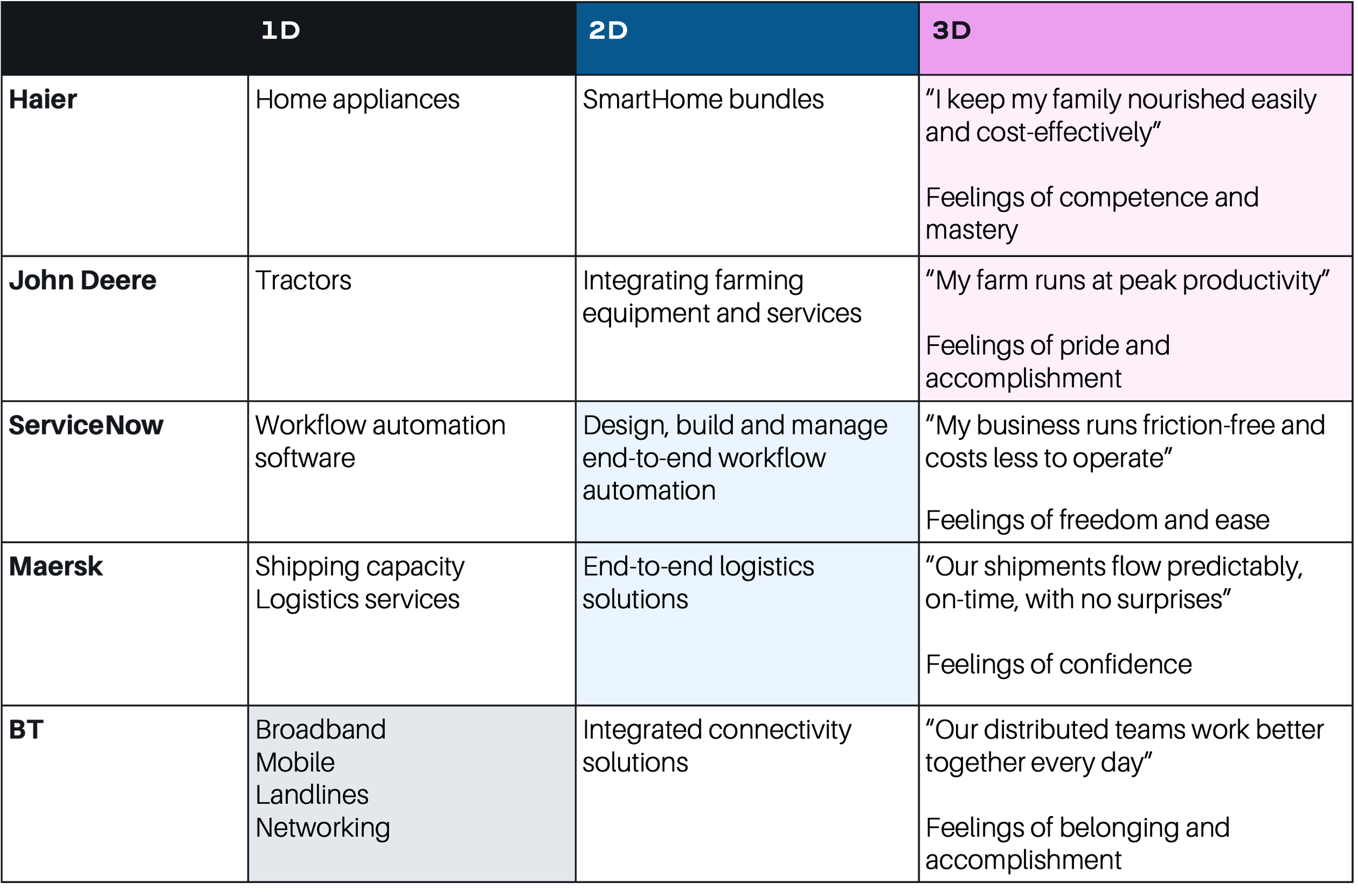
Here’s what this looks like for specific companies across 1D, 2D and 3D. The highlights show what game each company is playing now.
What it means for you
Most companies are running on an operating system they never consciously designed. It accumulated over time, function by function, hire by hire, until it became simply “how we work.”
Now everyone’s having to take a hard look at these underlying assumptions because AI performance and ROI depends on it.
To get from 1D to 2D, ask yourself:
Who is our best-fit customer? Chances are, 20% of your customers deliver 80% of your revenue. Who are they, and what do they really need?
What bundled solution will deliver on that need?
What cross-functional team can you assemble to make it happen?
Now (yes, AI comes last) how can AI and data make that solution even better and more cost-effective to deliver?
To get from 2D to 3D, start by asking:
What is the outcome our customers really want – regardless of whether we could deliver it ourselves?
What would it really take to make that outcome happen? What capabilities would we need and who could we partner with to get them?
In future newsletters I’ll map out some hypothetical ways that 2D companies like ServiceNow and Maersk could evolve to 3D and what capabilities are needed.
——-
Dear reader, I’d love to hear from you. What insights did you glean? What open questions do you have? What ideas did this spark?
And if you’re running a B2B business, I’m doing free diagnostic calls to help you identify your operating system and what needs to shift to be more competitive in an AI-powered era. You can book a call here.